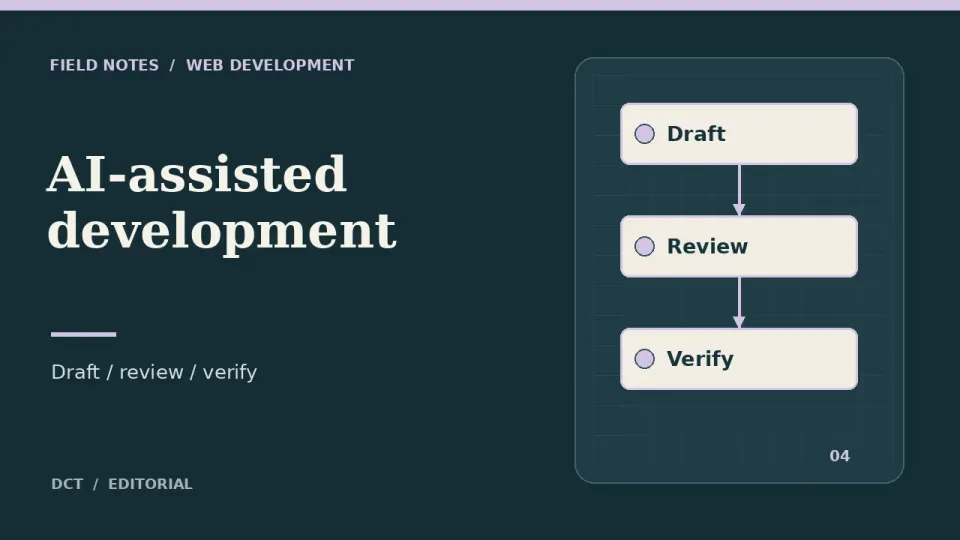
AI has become part of the way I work on websites. I find it useful for explaining unfamiliar code, drafting a component, investigating an error and helping me turn an idea into a small test. The difficult part is deciding when the result is ready to become part of a website I maintain.
A confident explanation and a correct implementation are two different things. I try to make the second one observable.
Give the task a boundary
When I ask for a change, I want to specify the existing behavior that must survive. A redesign of the product header should not quietly change the affiliate destination, delete metadata or rewrite every article using the layout. Those are separate responsibilities.
For a task involving a shared component, I would provide its caller, a representative data record, the expected output and a clear statement of what must stay unchanged. This gives the assistant a smaller problem to solve and gives me something specific to review.
I also prefer a coherent patch over dozens of commands that modify files in place. A manifest of intended paths makes it easier to see whether the change extends beyond its scope.
Read the change before running it
I look for unexpected imports, hard-coded destinations, changes to configuration and any operation that deletes or replaces data. A generated implementation can be syntactically valid while still changing the meaning of a page.
Suppose a card renderer checks for an optional logo. The empty case matters just as much as the full record. If the implementation uses a source file that is not available on the build machine, the card should have a safe fallback. I would test both records rather than assume the example shown in a preview represents all products.
Use different checks for different questions
A useful review checklist separates four layers:
- Source checks: schema, syntax, intended changes and reference paths.
- Build checks: the real compiler and generated routes, not just a code snippet.
- Browser checks: layout, keyboard interaction, narrow screens and dark mode when supported.
- Release checks: the expected version is public, links resolve and the previous version is recoverable.
A component fixture can catch layout problems early. It cannot tell me whether all production dependencies compile together. Likewise, a successful build does not prove that a screenshot was placed in a helpful part of an article.
Keep control of the final release
I treat generated changes as proposals until I have reviewed and tested them. For a local project, I can keep the current version, apply a patch and build. If the build fails, I want the actual error rather than another speculative redesign. Before committing, I inspect the diff and avoid staging unrelated local work.
The same principle applies to editorial work. AI can assist with structure and research, but it cannot supply personal experience that I never had. I verify product claims against appropriate sources and distinguish research from use.
AI saves me the most time when the acceptance criteria are clear. It is less valuable when I ask it to make something broadly better without saying how I will judge the result. For related notes, see what building websites has taught me and my approach to research.