The part of a content website that interests me most is the space between writing a draft and making it public. A page can look polished, but if publishing it requires editing a database by hand, copying images to several folders and remembering a list of URLs, the process will eventually become difficult to repeat.
My experiments with local Node.js tools, SQLite and static publishing grew from that problem. I wanted to understand the publishing process as a system. That does not mean a custom CMS is a better choice for everyone.
Content records and published pages are different things
Consider a software directory. A product record contains information that can be reused in an article, a comparison or a directory listing. If every page owns its own copy of that record, changing a product name or destination means finding all the copies.
A structured record gives the product an identity. An editorial article can then reference it, while retaining its own argument and context. I would also keep the commercial destination separate from the text describing the software. A change in affiliate status should not require rewriting an opinion.
SQLite is attractive for local tools because it gives me a relational model without running a separate database server. I can inspect data, define constraints and work with transactions. A static frontend can read an exported snapshot instead of requiring direct access to the editorial database at request time.
A publishing workflow needs visible states
A draft, a reviewed article and a live page should not be treated as interchangeable. A simple workflow I would use has four states:
| State | What it means |
|---|---|
| Draft | Content is editable and not public |
| Ready | Editorial and technical checks are complete |
| Scheduled | A reviewed version has an intended future release |
| Live | The public site is actually serving the release |
The distinction matters when a release is prepared in advance. A scheduled article can be corrected before its activation, while a live article should have a traceable update. Publication dates should describe the public history, not the time a file was generated.
Build a release, then activate it
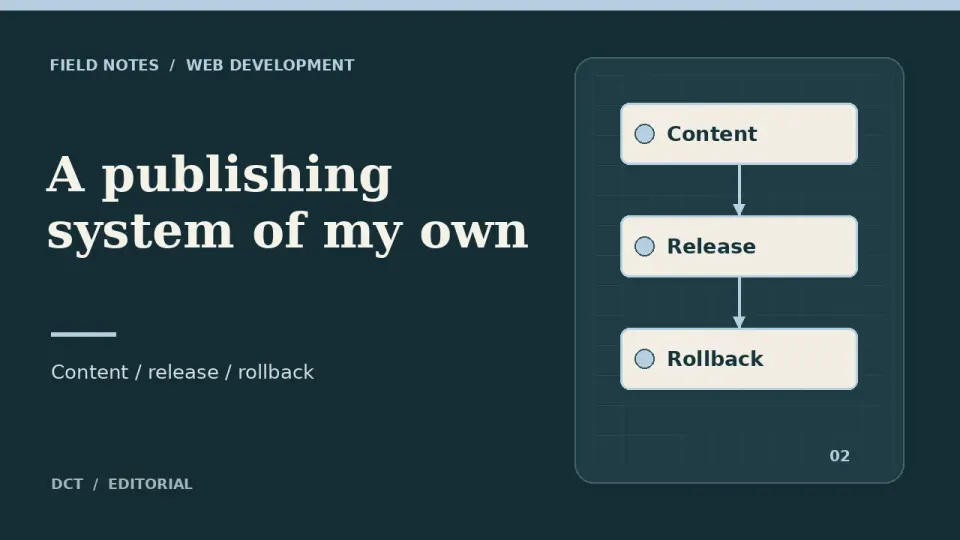
My preferred static publishing model is to prepare a complete version, validate its output and activate it as a unit. I want the public site to see either the old version or the new one, rather than a mixture of files copied halfway through a deployment.
For an illustrative implementation, a release might include HTML, images, search assets, a sitemap and a manifest of file hashes. The manifest helps answer whether a file was transferred correctly. It cannot prove that the article is accurate or that the interface looks good. Those are separate checks.
I would preserve the previous version until the new release has been verified. The rollback procedure should be understood before the system has a problem.
Know when the custom route is too expensive
A custom publishing tool takes time away from writing and operating the website. Authentication, media processing, validation and recovery all become responsibilities. A conventional CMS is often a better choice when several people need to write and edit ordinary pages in a familiar dashboard.
I find this approach worth exploring when the content has relationships, the publishing workflow repeats frequently and the frontend has a predictable output. For a simple personal site, I would start with Astro content collections before reaching for a separate administration system. The underlying lesson is to solve the editorial problem first and add software only where it removes recurring work.
For the deployment side, see my VPS learning path. For a smaller exercise in choosing the right architecture, I explain content models in WordPress and Astro.