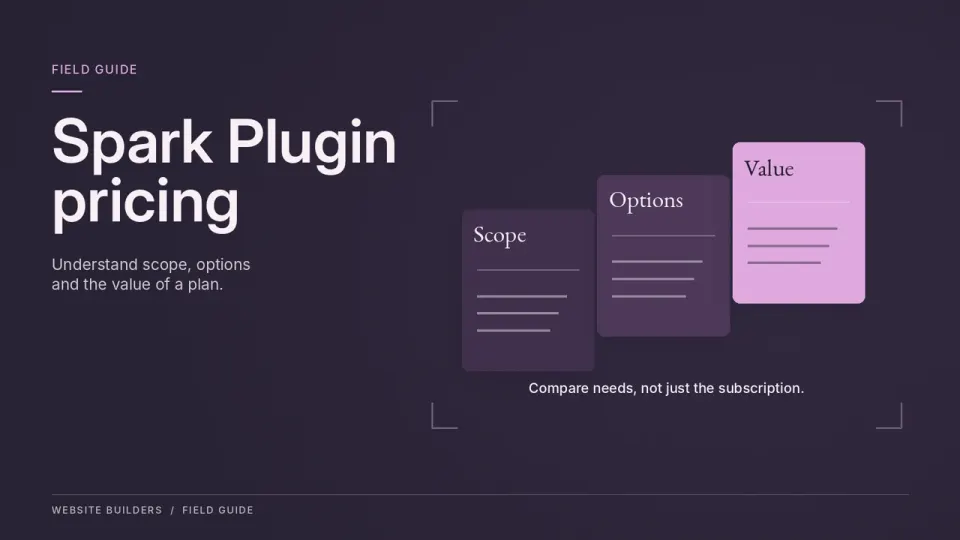
Research-based guide; no hands-on product test.
Limited selection of customization types.
Broader feature access, including Pro options.
Client-site management and conditional persistence.
Calculate ordinary renewal, plan upgrade and remaining support costs.
Two subscriptions with similar names
Squarespace and Spark Plugin each use their own plan terminology. A Spark Personal subscription does not make a Squarespace Personal or Basic site compatible. Check for a Squarespace 7.1 site with code injection before comparing the Spark plans.
According to the Spark pricing FAQ, Personal permits a limited selection of customization types (up to ten); Business removes that limit and includes Pro functionality. Agency addresses managing client websites. Treat these as separate product tiers, not as upgrades to Squarespace itself.
The vendor describes a 14-day full-access trial. Its current pricing FAQ also distinguishes cancellation: Personal and Business changes are hidden when the subscription ends; Agency persistence requires a qualifying annual subscription or 12 months. Confirm the current offer before paying. Official pricing and terms.
Model the recurring cost
Use this worksheet with the current checkout amounts. These are inputs, not advertised prices.
| Input | Annual cost calculation |
|---|---|
| Squarespace | Annual renewal or monthly rate multiplied by 12 |
| Spark Plugin | Actual renewal charge for your selected tier |
| Other services | Domain, email, commerce integrations |
| Maintenance | Your own time or developer support |
For a client project, also ask who pays and who owns the subscription. A design depending on the add-on may change when billing stops. The vendor describes different cancellation behavior for individual/business versus qualifying agency subscriptions. Read the current minimum-term condition before relying on continued customization.
Compare the decision for three site owners
| Project | First tier to investigate | Reason |
|---|---|---|
| Solo portfolio | Personal | A small number of recurring design treatments may be enough. |
| Services site with advanced content presentation | Business | Check Pro features such as pricing sections or advanced navigation. |
| Designer managing client sites | Agency | Verify site allowances, billing, handoff and persistence conditions. |
Do not use the table as a substitute for reading the actual account offer. The same site could qualify for a smaller tier if it uses no Pro customization. A developer working on one client’s site may prefer a client-owned subscription rather than managing several subscriptions on the developer’s account.
For a concrete budget exercise, assume your own maintenance rate is $30 per hour and a custom solution takes two hours to implement, then one hour a year to maintain. The first-year labor estimate is $90 before any website fees. Compare that estimate with the actual Spark renewal and any additional cost of moving to an eligible Squarespace plan. These numbers illustrate the method; they are not vendor prices or measured implementation times.
My decision rule
Choose the smallest compatible combination that meets the list of necessary features. If the checkout does not make the renewal or site allowance clear, ask support before paying. Use the official pricing page and checkout for the actual renewal amount, currency, billing period, tax and promotion expiry. The examples above are not quoted subscription prices.
A break-even worksheet for a real project
Let S be the existing yearly Squarespace cost, U the extra cost of moving to an eligible site plan, P the yearly Spark renewal and H the annual labor estimate for the competing custom implementation. If other services are unchanged, the relevant plugin cost is U plus P. Compare that figure with H, then check whether both options meet the same requirements. Do not count the whole Squarespace subscription twice.
| Scenario (illustrative, not vendor prices) | Plan upgrade | Add-on renewal | Custom work |
|---|---|---|---|
| Already eligible | $0 | $120 | $180 |
| Upgrade needed | $96 | $120 | $180 |
In the first example the add-on costs $60 less than the labor estimate. In the second it costs $36 more. Actual results depend on the selected plan, currency, support arrangement and time spent. Include any ongoing developer time needed to resolve conflicts even if you buy the add-on.
For an agency, make a separate row for every client website and verify the applicable site allowance. A low monthly headline does not establish the cost per client or what remains active after cancellation. Confirm the minimum term in the vendor’s subscription terms.
Compare two-year and three-year costs
Assume, for illustration only, that a website owner is already on an eligible site plan and the intended add-on costs $180 a year. A scoped custom implementation is estimated at $240 upfront, plus $60 each following year. Over one year the add-on estimate is $180 versus $240. Over three years it is $540 versus $360, before considering additional support or revisions. If the add-on enables new requirements every year or saves repeated development requests, that comparison may reverse. These are made-up budget inputs for teaching the calculation, not Spark prices or measurements.
Now assume the site needs a $72 annual plan upgrade only to support the add-on. Over three years that adds $216. If the higher plan also serves another independent requirement, allocate the difference transparently rather than charging the whole amount to the plugin. The relevant decision is the extra cost caused by the choice.
Before using a calculator, decide what belongs in each side: the current Squarespace plan cost cancels out if it is the same for both; unrelated domain fees also cancel out. Include the custom implementation’s own maintenance, the add-on’s configuration and any developer time that remains necessary. A spreadsheet is useful only when the two alternatives meet the same acceptance criteria.
Agency pricing needs a per-client view
A designer with several sites should make a row for each client, listing the required features, who owns the website account, who pays for Spark and what the client expects after termination. Check the site allowance and any minimum subscription condition against the current terms. If the client expects the design to remain active without recurring payments, confirm the precise agency eligibility and persistence conditions before putting that promise in a proposal.
The agreement should also specify who will receive notices, who can change the design settings and who handles a conflict with another integration. I would not assume that a dashboard managing several sites removes all the maintenance work. A client-owned Business subscription might be the simpler arrangement for one project; an agency subscription may become relevant for a different operating model. The exact cost must come from the actual account offer.
Keep a renewal record
Before payment, record the billing currency, tax, charging frequency, amount due, ordinary renewal, cancellation procedure and what happens to customizations. Save the vendor’s offer or invoice privately. Revisit it before renewal with the actual list of features in use. If the site no longer needs them, compare the removal cost against another year of subscription. This is also the point where I would check whether a temporary trial or discount changes any conditions. A monthly headline is never a substitute for a complete cost record.
Enter your own estimates in USD. Default values are illustrative only and are not vendor prices.
In this example, custom work costs $336.00 less over 3 years.
If the available customizations fit your project, visit Spark Plugin to review the current subscription and any offers available directly from the vendor. Check the final checkout amount and ordinary renewal before subscribing.
Referral link — commission attribution is not confirmed. Check current Spark Plugin plans and terms ↗
If you decide to try Spark Plugin, check whether the code SPARK20 still gives you 10% off at checkout.