Official references: For baseline WordPress theme concepts, use the WordPress Theme Handbook. Theme-specific buying decisions still need current pricing and feature checks from each vendor.
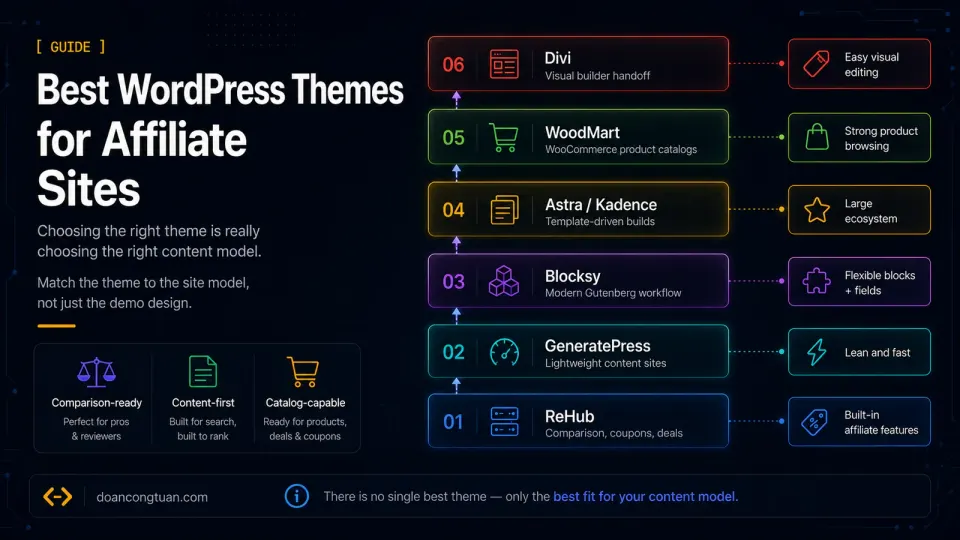
The first mistake most people make when choosing a WordPress theme for an affiliate site is treating it as a design decision. They look at screenshots, demo sites, and feature lists, pick the one that looks closest to what they want the site to look like, and buy it.
The problem shows up two months later when they are fighting the theme to do things it was not designed for. A comparison table that requires five plugins because the theme does not have one built in. A review layout that generates awkward HTML because the theme was designed for portfolios. A product box that breaks the layout because the theme was never intended for affiliate product data.
Choosing a WordPress theme for an affiliate site is really choosing a content model. The theme determines what content structures are easy to build, what features come built in versus assembled from plugins, and how much ongoing configuration complexity you accept. Get this right before you start building and the rest is manageable. Get it wrong and every piece of content you publish works against the theme you chose.
What Makes a Good Affiliate WordPress Theme?
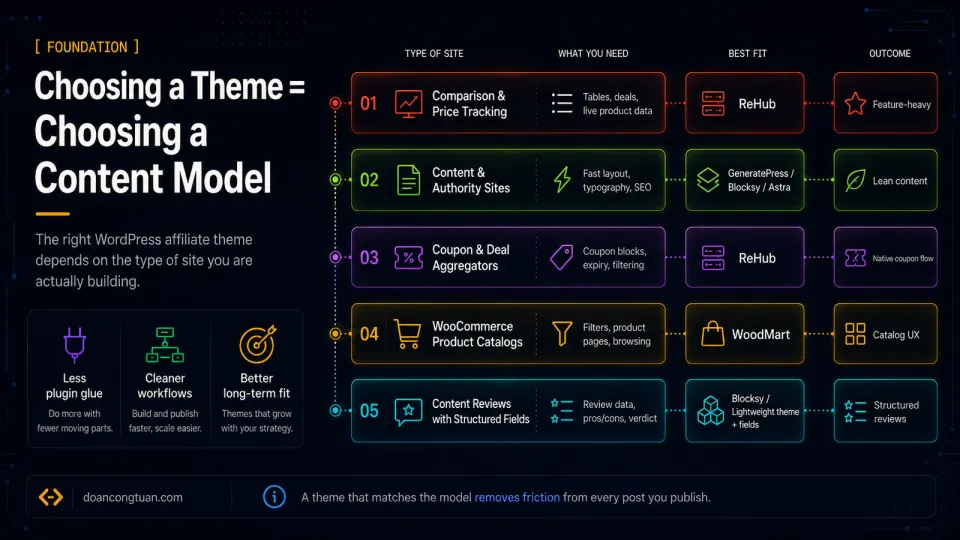
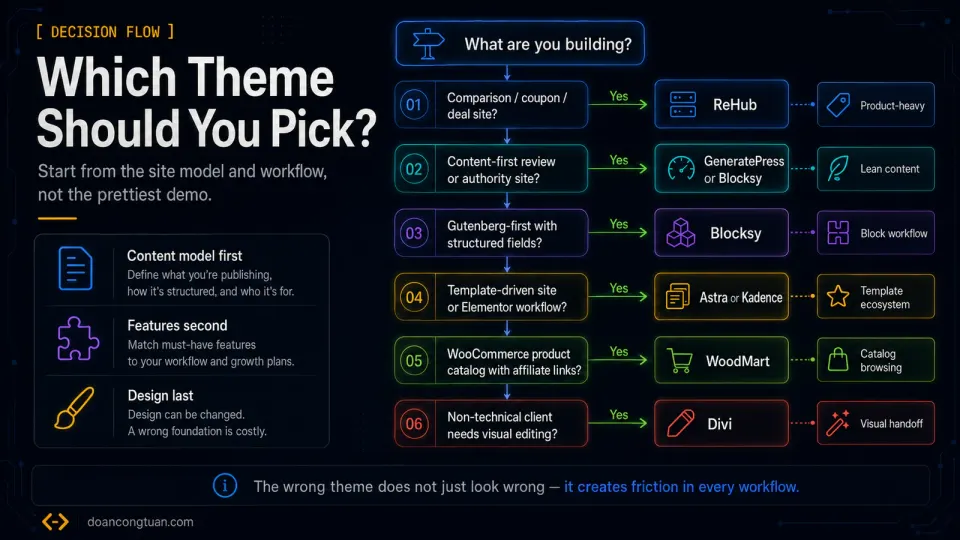
The right affiliate theme depends on what kind of affiliate site you are building. These are meaningfully different content models:
Product comparison and price tracking sites need comparison tables, deal blocks, coupon sections, live product data integration, review rating formats, and structured data for products and reviews. ReHub is built for this. Almost nothing else is.
Content and authority sites need a fast base, clean article layout, good typography, flexible header and footer, and strong SEO compatibility. The affiliate links happen inside content, not in dedicated product comparison sections. GeneratePress, Blocksy, and Astra all serve this model well.
Coupon and deal aggregators need structured coupon layouts, expiry date display, deal blocks, and category filtering. ReHub covers this natively. A custom ACF Pro setup on a lightweight theme can also work if the catalog size is manageable.
WooCommerce affiliate product catalogs — sites that import products into WooCommerce with affiliate buy links instead of real cart/checkout — need deep WooCommerce integration: custom product page layouts, AJAX filters, and category browsing. WoodMart is designed for this. ReHub supports it too.
For this model, the WooCommerce documentation matters more than theme demo screenshots, because product structure and catalog behavior become part of the affiliate system.
Content sites with product reviews sit between authority sites and full comparison sites. A lightweight theme with a review-style custom post type or ACF fields, combined with Rank Math’s built-in review schema, often handles this better than a heavyweight affiliate theme.
ReHub: Best for Serious Affiliate and Product Sites
ReHub is the most purpose-built affiliate theme available for WordPress. Not adapted from a general theme with affiliate features added — built from the ground up for comparison, review, coupon, and deal content.
What it includes natively: product comparison tables, multiple review score formats, deal blocks, coupon display with expiry dates, price history, Content Egg deep integration, and structured data for product reviews and ratings. Each of these would require a separate plugin on a general theme. On ReHub, they are part of the design system.
That is why the WordPress Plugin Handbook is still a useful baseline here: once a theme starts replacing several plugins, you need to judge it as part theme and part feature system.
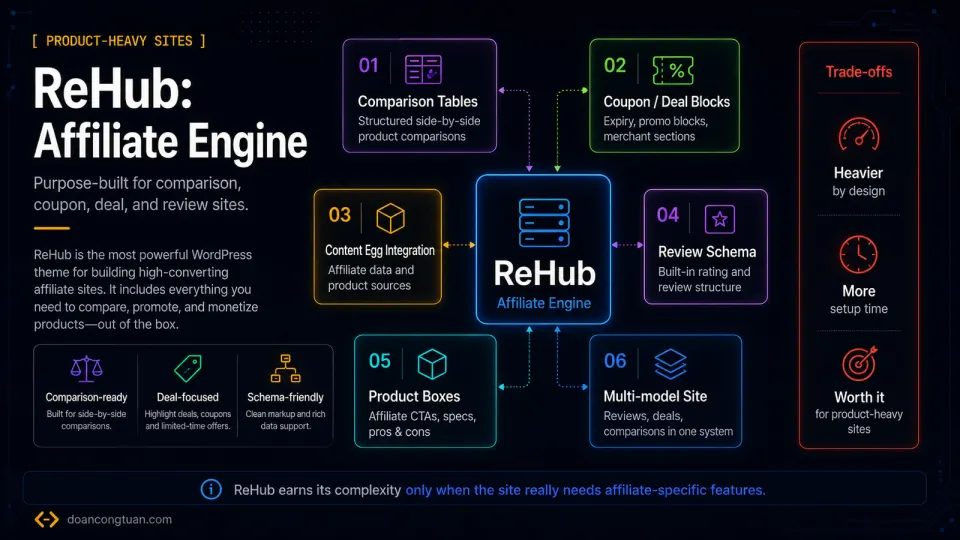
Good fit: Comparison sites with live pricing from multiple networks, coupon aggregators, deal roundup sites, review sites with structured product data and ratings.
Not a good fit: Authority blogs that mention products without structured comparison, simple content sites with affiliate links in articles, sites where load time and Lighthouse scores are primary metrics.
Pricing: ThemeForest one-time license. Verify current pricing at the official site.
GeneratePress: Best for Lightweight Content Sites
GeneratePress is the theme most consistently recommended by developers who build performance-sensitive content sites. It is a minimal base theme with a modular Premium add-on system — you activate only the modules you need, and the rest does not load.
The structural advantage for affiliate content sites: a theme footprint that does not fight caching and performance optimization. When Layer 1 (hosting) and Layer 3 (page cache) are correctly configured, a GeneratePress site on a good VPS will score well in Core Web Vitals without heroic optimization.
The honest trade-off: GeneratePress requires meaningful customization to produce a visually distinctive site. The blank canvas is an advantage for developers who want control. It is a source of friction for people who expected a theme to provide a ready-made design.
GeneratePress pricing has changed over time, so I would not treat old lifetime-plan references as current buying advice. Check the official GeneratePress pricing page before purchasing, especially if you are comparing annual, bundle, or multi-site options.
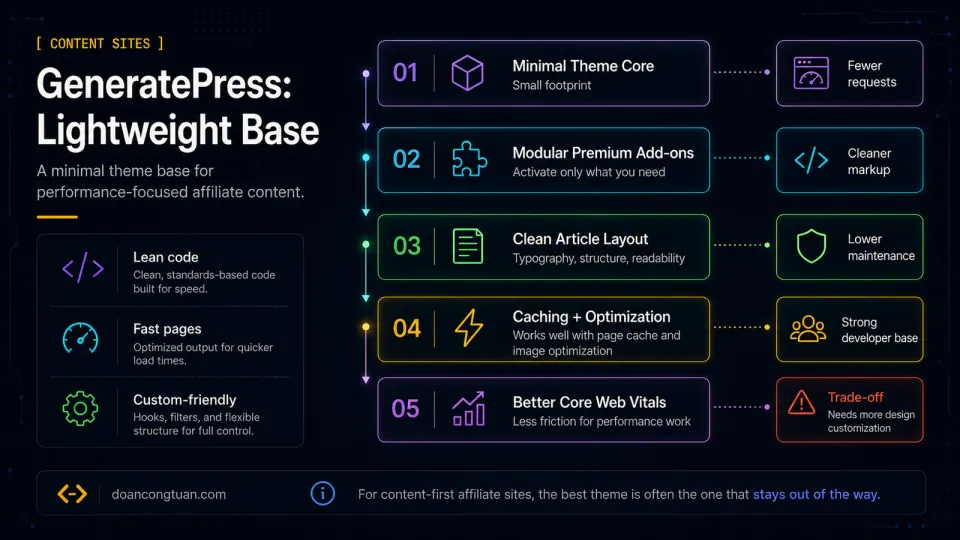
Good fit: Content and authority sites, niche review blogs, sites where Core Web Vitals and performance scores are a priority, developers who want a reliable base theme for custom development.
Not a good fit: Sites needing affiliate-specific features built in (comparison tables, deal blocks), non-technical clients who need a visual editing experience, Gutenberg-first development.
Blocksy: Best for Flexible Modern WordPress Sites
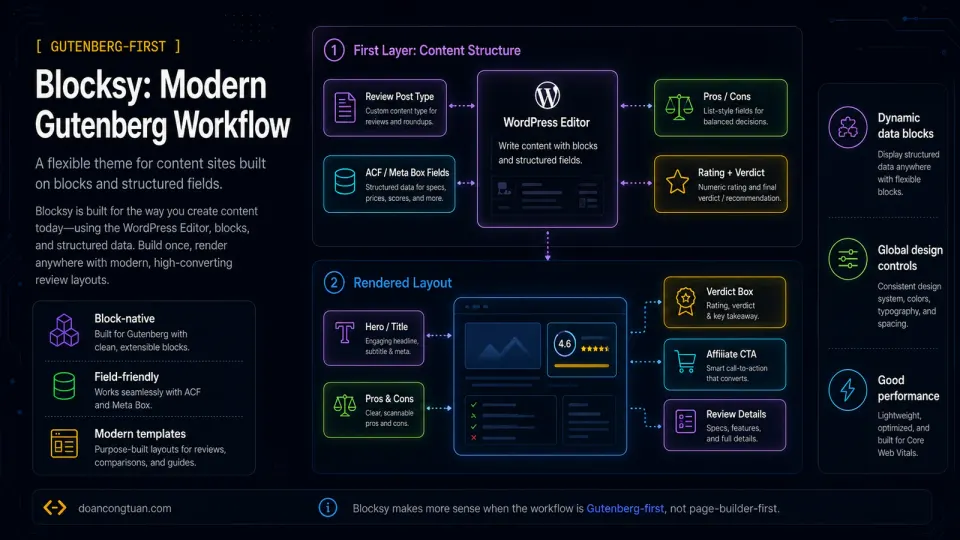
Blocksy is the theme I have used in Amazon niche affiliate workflows as a lighter alternative to ReHub for content-first sites. It is designed for the modern WordPress block editor — not adapted from a classic theme architecture.
The free core theme is genuinely capable without the Companion Pro plugin. Dynamic data blocks connect directly to ACF and Meta Box fields, which matters for structured affiliate content: a review post type with custom fields for rating, verdict, pros, cons, and affiliate link can render those fields directly in block templates without custom code.
For Gutenberg-first affiliate sites — sites built on the modern block editor rather than Elementor — Blocksy offers global design controls, a clean template system, and good performance without the weight of a full affiliate theme like ReHub.
The community is smaller than Astra or GeneratePress. When you hit an edge case, fewer third-party tutorials exist. Blocksy’s own documentation is good, but the resource depth is not the same as older themes with larger communities.
Good fit: Content sites built on Gutenberg, affiliate blogs using ACF custom fields for review data, developers who prefer modern WordPress patterns over classic theme architecture.
Not a good fit: Elementor or Divi users, sites needing affiliate-specific comparison tables out of the box, users who need a large tutorial library.
Astra and Kadence: Best for Template-Driven Builds
Astra and Kadence are two of the most widely installed WordPress themes. Both offer capable free core themes with paid Pro versions that add advanced customization.
Astra’s main strength is ecosystem size: a large starter-template library, broad Elementor compatibility, and a very large WordPress user base. When you encounter a common Astra problem, there is usually documentation, forum discussion, or a tutorial somewhere. For agencies building many client sites where a reliable, well-documented base matters, Astra is a defensible default.
For affiliate sites specifically, Astra works well as a base when paired with a page builder for layout and Rank Math for schema. It does not have the affiliate-specific features ReHub includes, but for a content-first affiliate site, it covers the requirements without those features.
Kadence’s main strength is the free tier quality and tight Gutenberg integration. The Kadence Blocks plugin extends the theme with a cohesive design system. Global colors and typography apply consistently across Kadence Blocks components. For Gutenberg-based affiliate sites that prefer Kadence’s ecosystem over Blocksy, it is a solid choice.
Note: Kadence was acquired by Liquid Web. The product continues to be developed, but the acquisition creates some uncertainty about long-term direction that is worth knowing before building a site architecture around it.
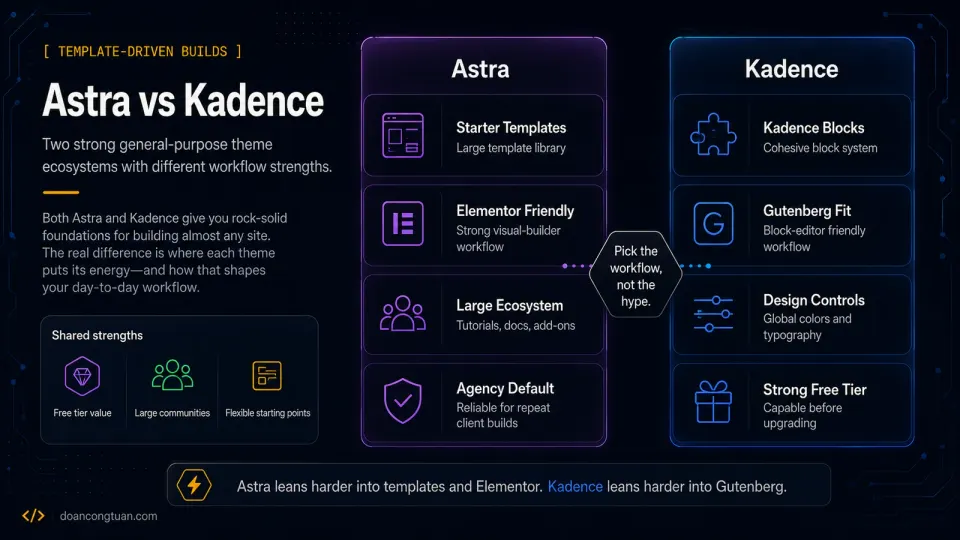
Good fit for both: Template-driven agency builds, Elementor-based projects (Astra), Gutenberg block-editor projects (Kadence), developers who want maximum tutorial availability.
Not a good fit for either: Sites needing ReHub’s affiliate-specific comparison features, performance-critical sites where GeneratePress or Blocksy have a structural advantage.
WoodMart: Best for WooCommerce Product Catalog Style Sites
WoodMart is purpose-built for WooCommerce — deep product page customization, AJAX category filters, quick view, product comparison built in, swatches for variable products, and a large library of pre-built shop layouts.
For affiliate sites that structure products through WooCommerce with affiliate buy links instead of real cart functionality, WoodMart provides the product browsing experience — filters, product grid, custom product pages — without requiring a full ecommerce setup.
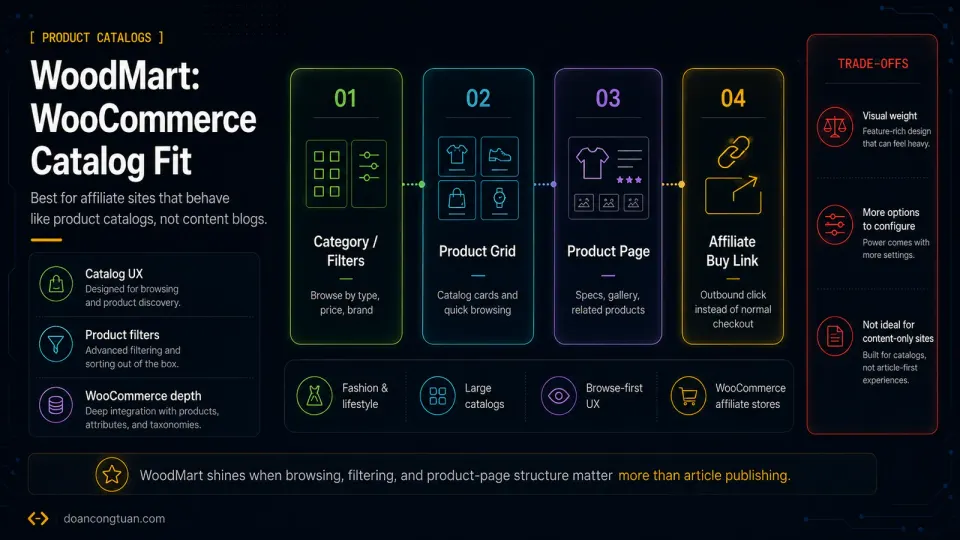
Good fit: WooCommerce affiliate product catalogs, fashion and lifestyle stores, shops needing advanced product filtering and browsing.
Not a good fit: Content-only affiliate sites without WooCommerce, comparison sites with live pricing from multiple sources, sites where WoodMart’s visual weight conflicts with performance targets.
PremiumPress: Dedicated Niche Themes for Coupon and Directory Sites
PremiumPress is different from every other theme in this article: it does not try to be a general WordPress theme. It makes a dedicated product for each niche — a coupon theme, a job board theme, a classified ads theme, a directory theme, a freelance marketplace theme. Each one is purpose-built for that content model.
For coupon and deal aggregator sites specifically, the coupon theme includes structured deal listings, expiry date display, category filtering, and offer card layouts without requiring ACF or additional plugins to create those structures. That covers the same ground ReHub’s coupon features cover, at a lower configuration cost if coupon-focused functionality is the primary need.
The tradeoff I noticed: the site ran heavier than I expected. The frontend relied on AJAX for interactions, which added JavaScript weight that required active management for Core Web Vitals. This is not unusual for feature-dense niche themes — the functionality has to come from somewhere — but it is worth factoring in before choosing PremiumPress over a lighter base theme with plugin assembly.
Good fit: Dedicated coupon or deal sites, local directory sites, small job boards, classified ad sites, and freelance marketplace projects where the site purpose matches a PremiumPress product exactly.
Not a good fit: General affiliate content blogs, authority sites, or performance-sensitive projects where Core Web Vitals need to be clean without significant optimization work.
Pricing: One-time per-theme licensing. Check the official PremiumPress page for current prices.
Elegant Themes / Divi: Best for Visual Builder Workflow
Divi is a visual drag-and-drop page builder that requires the Elegant Themes membership. The appeal is genuine design control for non-technical users without writing code. The trade-off is also genuine: heavier markup than lightweight themes, meaningful vendor lock-in, and slower performance compared to structural alternatives.
For affiliate sites, Divi is the right choice when the workflow priority is visual design control for a non-technical editor, not performance scores or code quality. For agencies delivering sites to clients who will manage their own layouts after handoff, Divi’s editing experience is genuinely more accessible than the WordPress block editor.
For developer-built affiliate sites where SEO performance and Core Web Vitals scores matter, the structural weight of Divi is a real cost. A lightweight theme such as GeneratePress or Blocksy will usually have a structural performance advantage, assuming the same hosting, content, and plugin load.
Good fit: Client sites where non-technical users manage their own layouts, visual-first marketing and landing pages, agencies with a Divi workflow already established.
Not a good fit: Performance-sensitive affiliate sites, developers who care about code quality and maintainability, sites that may need to change theme architecture in the future.
Decision Table
| Factor | ReHub | GeneratePress / Blocksy | Winner |
|---|---|---|---|
| Comparison tables built in | Yes — native feature | No — plugin or custom code needed | ReHub |
| Content Egg integration | Deep native integration | Shortcodes/blocks only | ReHub |
| Theme weight and performance | Heavier — features add weight | Lightweight — minimal by design | GeneratePress / Blocksy |
| Setup time | High — configuration-heavy | Low to medium | GeneratePress / Blocksy |
| Content/authority blog fit | Over-engineered for this use case | Natural fit | GeneratePress / Blocksy |
| Gutenberg block editor fit | Has block support, not native-first | Blocksy is Gutenberg-native | GeneratePress / Blocksy |
| Review schema and structured data | Built in natively | Via Rank Math plugin | Depends |
| One-time vs subscription pricing | One-time license (ThemeForest) | Annual or lifetime license | Depends |
What I Would Choose Today
For a new affiliate content site that publishes reviews, roundups, and comparison articles without live pricing comparison tables: Blocksy (free) or GeneratePress (free core, Premium when needed). Start fast, stay lightweight, add Rank Math for schema.
For a new product comparison or coupon site with Content Egg and structured product data: ReHub. Accept the configuration investment because the features justify it for this content model.
For a WooCommerce affiliate product catalog: WoodMart if the catalog is the main experience. ReHub if comparison and deal blocks matter more than WooCommerce depth.
For a site I am handing off to a non-technical client who will manage their own layout: that is a conversation about Divi or a managed WordPress solution — and a separate conversation about whether an affiliate theme is even the right architecture for client-managed content.
The theme that fits the content model is the right theme. The theme that fights the content model costs more than its license fee in ongoing friction.
Frequently Asked Questions
What is the best WordPress theme for affiliate marketing?
Is ReHub good for affiliate sites?
Is GeneratePress better than Astra?
Is Blocksy good for content sites?
Should I use Divi for an affiliate site?
What theme should I choose for a small affiliate blog?
Related Pillar Guides
- Best WordPress tools for affiliate sites — the broader stack around themes, SEO, speed, and content.
- WordPress performance stack — how theme weight affects speed and optimization decisions.
- WordPress VPS hosting — when hosting should be upgraded before changing themes.
- WordPress vs modern stack — when WordPress themes are still useful, and when another stack may fit better.
- Astro for WordPress developers — what changes when you move from themes to components and MDX.