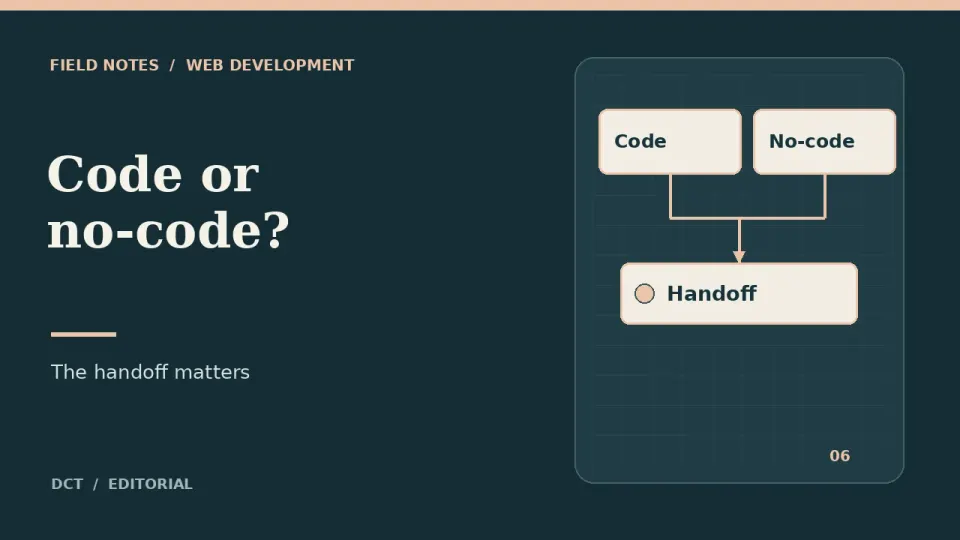
A platform comparison usually begins with features. I would rather begin with the person who has to keep the website running after launch. That person may be a business owner, an editor, a marketing team or another developer. The right platform for me is not automatically the right platform for them.
I have a more specific client intake framework for choosing between platforms. Here I want to focus on one part of that decision: the handoff.
Give the future owner a normal task
Imagine a small business site that needs its services updated every month. Instead of demonstrating the most impressive animation in a prototype, ask the person who will maintain it to update a service description, add a photo and check the result on mobile. Ask them how they would undo the change if it were wrong.
A visual tool might make this easy, but a poorly organized template can still confuse an editor. A code-first site can work well for a developer-owned publication, but its editing workflow may be unsuitable for a client who has never used Git. The exercise reveals which assumptions are actually true for this particular owner.
Write down who owns each responsibility
The following is a hypothetical handoff checklist I would use, regardless of the technology.
| Responsibility | Acceptance question |
|---|---|
| Content | Can the owner change a normal page without help? |
| Media | Can they replace an image without breaking the layout? |
| Access | Who owns the domain and can recover the account? |
| Publishing | Is there a preview and a deliberate release action? |
| Recovery | Can the last good version be restored? |
| Exit | Can important content and assets be retrieved in usable form? |
The result may be different for every project. I would include the answers in the brief, not assume the vendor or developer automatically covers all of them.
Compare the ongoing work, not just the first build
For WordPress, someone needs to be responsible for updates, backups and hosting. The actual workload depends on the stack and service arrangement. For a static site, the owner needs a reliable way to edit and release content; it is possible to add an editing interface, but that has a cost. A managed platform changes the division of work again and introduces subscription and portability questions.
A simple comparison starts with the monthly cost, then adds the owner’s expected time and any developer support required. I have a three-year cost guide with an interactive example for this. The estimate should use actual project requirements rather than an assumed saving from a particular framework.
Make the first month a test of the operating model
For an example project, I would agree on a few representative edits before handoff and observe whether they can be completed. If a requirement fails, the platform might still be suitable with a better content model or a simpler editor. If the owner repeatedly needs help for routine changes, the ongoing cost belongs in the platform decision.
This is where the choice between code and no-code becomes a practical one. I care less about the label than whether the person maintaining the site has the access, skills and workflow to do it confidently. The Website Builders guide and WordPress versus Astro comparison give several starting points for that discussion.