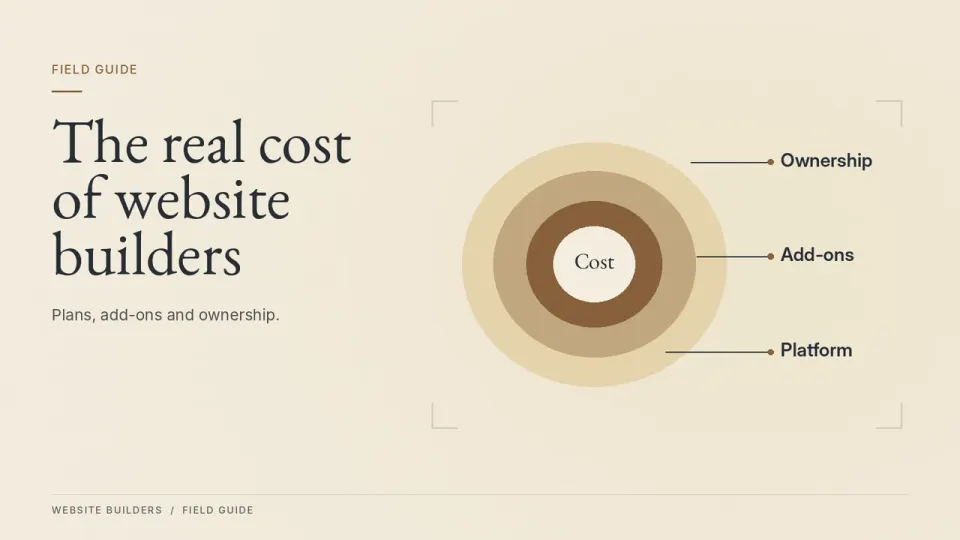
A website quote can look inexpensive until the business needs a booking system, a second editor or a different CMS plan. I have learned the same lesson in WordPress: the software price and the cost of operating a site are two different numbers. A hosted builder moves some responsibilities into a subscription, but it does not remove the other costs of running a website.
This worksheet is intended for a freelancer or small business comparing Squarespace, Wix, Framer and Webflow. The example figures are hypothetical USD budgets, not vendor quotes. Use the actual plan and renewal price for your account and region.
Start with requirements that affect billing
Before opening a pricing page, write down the features required at launch. Does the site need a custom domain, an online store, a booking flow, multiple languages, a growing CMS or more than one person with publishing access? Record the required number of websites, editors, content records and expected traffic. If a feature is optional, put it in a separate future budget instead of charging for it today.
A brochure site and a service business should not be compared using the same entry-level plan. The first may need only a few pages and an inquiry form. The second may need subscriptions, scheduling, payment providers and staff permissions. When a design extension is required, include any upgrade to the underlying website plan in the extension’s actual cost.
Setup, first subscription invoice, domain and required services.
Renewals, editor access, usage and maintenance.
Eligible sales fees, payments and administrative time.
Content recovery, redirects and reconstruction.
Compare equivalent deliverables using dated account quotes, not headline monthly prices.
What to check on each pricing page
| Product | Pricing source | Additional cost questions |
|---|---|---|
| Squarespace | Plans | Separate scheduling, email, domain and commerce charges |
| Spark Plugin | Pricing | Compatible site plan, site count and cancellation conditions |
| Wix | Plans | Required business features, apps and renewal terms |
| Framer | Pricing | Full/content editor seats, CMS, localization and usage |
| Webflow | Pricing | Site plan, Workspace plan, capacity and add-ons |
Two billing details deserve special attention in 2026. Framer’s subscription guide distinguishes full editors and content editors, so an agency’s solo account may cost less than the client’s eventual team. Webflow’s plan change notice explains the move from CMS and Business Site plans to Premium. Neither platform should be budgeted using an old screenshot without checking the current account.
Build a three-year model
I separate cash charges from the labor required to operate the site. For a three-year cash estimate, add the setup charge, the actual first-year recurring bill, two years of renewal charges, planned paid changes, and expected usage and transaction charges. Add taxes where applicable. If the vendor quotes an annual plan as a monthly equivalent, multiply by twelve to estimate the yearly charge, then check the actual invoice before purchase.
The following example deliberately assigns different costs to two imaginary approaches. It is not a comparison of named vendors. Both must satisfy the same business requirements.
| Cash cost (USD) | Option A | Option B |
|---|---|---|
| Initial setup | 600 | 1,100 |
| Year 1 plan and add-ons | 360 | 240 |
| Year 2 renewal and add-ons | 420 | 300 |
| Year 3 renewal and add-ons | 420 | 300 |
| Planned paid maintenance over three years | 180 | 300 |
| Total before usage, taxes and payment fees | 1,980 | 2,240 |
Option A costs $260 less in this example. Now value the owner’s time: if A requires 30 extra minutes of maintenance each month, that is 18 hours over three years. At a hypothetical $20 per hour, the additional labor value is $360, reversing the comparison. If those hours do not have an actual financial opportunity cost, keep them visible as time rather than presenting the amount as a cash expense.
Do not add the same developer support twice. A maintenance contract that already includes a monthly content edit should not also be counted as a separate paid edit. Likewise, a domain included in an introductory offer should appear as a zero first-year line and a real renewal line in later years, not disappear from the worksheet entirely.
Change the time assumptions before choosing a quote
The $260 cash difference in the example is spread across 36 months. At an assumed value of $20 per hour, the break-even additional workload is about 22 minutes per month for Option A. That is a much smaller difference than a typical platform comparison acknowledges. If the owner cannot reasonably assign a monetary value to those hours, compare the cash figures and the time burden separately.
Use the worksheet below to replace the sample cash totals and the additional monthly time. Its labor-adjusted result is a planning estimate, not an invoice or a prediction of revenue. The time difference may be negative when A saves time compared with B. A useful proposal records who supplied the estimate and whether the workload is likely to change after the site is handed over.
Enter total cash costs for each option and the extra monthly time required by A compared with B. All amounts are in USD.
After accounting for the extra time, B has an estimated $100.00 advantage over three years.
Commerce and payments can change the decision
Suppose a store processes $24,000 in eligible sales per year and one hypothetical plan adds a 2% platform transaction charge that another plan does not. That difference alone would be $480 per year, separate from any payment processing fees. A $180 annual plan upgrade could be financially sensible if it eliminates that charge for the same eligible transactions. Confirm the actual rate, transaction definition, payment provider and applicable exclusions before applying this calculation.
Keep platform transaction fees distinct from processor fees, currency conversion and refunds. Avoid treating revenue as profit when comparing the benefit of an online store. For appointment businesses, also consider the cost of staff time spent managing cancellations or resolving failed payment records. A more expensive plan that avoids manual administration may be the better operating choice.
Include the cost of leaving, but keep it separate
A migration estimate is not necessarily a recurring expense. It is a risk scenario: what if the business needs to move in year three? List the pages, original assets, content records, redirects, customer workflows and integrations that would need to be recovered or recreated. Then estimate the time or external development cost for that specific move. Do not silently add it to every year’s subscription bill.
I would maintain a small exit folder with copies of approved content and a route map. For Webflow and Framer in particular, confirm the practical export workflow and hosted service dependencies; see the Webflow review and Framer review for the distinctions. The domain should be controlled by the business, regardless of the builder it selects.
Compare with a self-hosted option only when relevant
If a project requires independent hosting or custom WordPress functionality, include a separate self-hosted quote. This has its own renewal costs, backups, updates and developer time. For a small WordPress project I would compare entry-level hosting and its renewal terms; for more demanding workloads I would assess managed hosting separately. Do not purchase hosting for a managed website builder simply because a provider is listed here.
Affiliate disclosure: I may earn a commission if you purchase through this link. Check Hostinger for a self-hosted WordPress alternative ↗
Affiliate disclosure: I may earn a commission if you purchase through this link. Explore Cloudways if managed WordPress hosting fits your brief ↗
Use the Squarespace vs WordPress comparison to decide whether that alternative belongs in the brief at all.
Before committing to a plan
Ask the person responsible for billing to review the three-year quote. Verify the first invoice, renewal amount, collaborator requirements, add-on cancellation rules and region-specific payment support. Save the date and source of every quoted charge. Revisit the assumptions if the site gains another editor, a new store or a second language.
My aim is not to minimize the hosting line at any cost. It is to make the total cost visible before the business commits to a platform. A predictable, slightly higher subscription may be perfectly reasonable when it supports the required workflow. The client selection guide connects the budget to the original project brief.