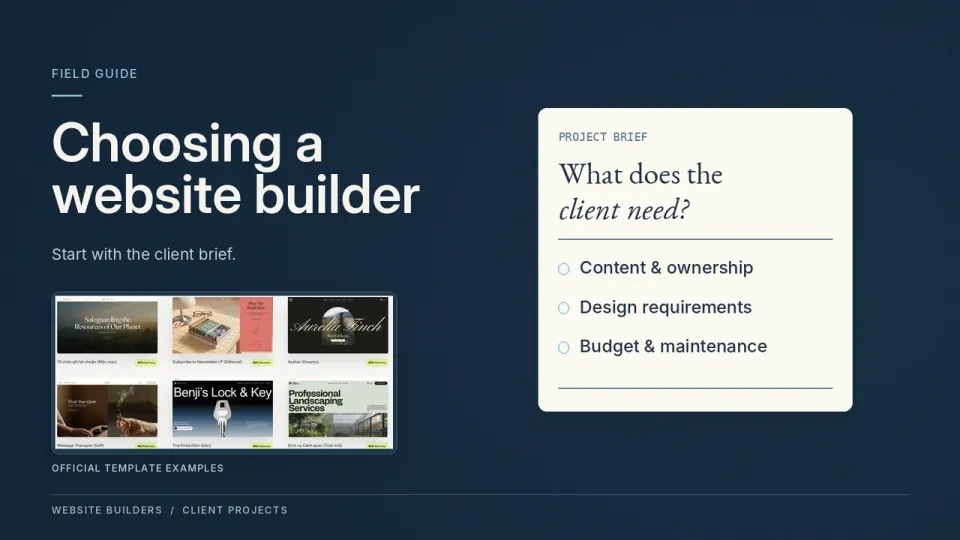
My experience building WordPress client sites has shaped the way I think about a project. Plugins and themes offer many ways to solve a design problem, but updates, content changes and the health of the installation remain long-term responsibilities.
Today I would start a client conversation with the operating model. A managed builder is a legitimate option when the business does not want to run a server or maintain a software stack. I would still choose a developer-owned approach for some projects. That is why I would rather use a brief and a small prototype than announce a favorite platform at the first meeting.
Meeting one: ask about the job the site needs to do
I would write down one primary outcome for the site: qualified inquiries, appointments, sales, a portfolio, a growing publication, or something else. Ask the client for two examples of what they consider a successful visitor journey. If the business is a tutoring center, the outcome may be an inquiry followed by a trial lesson. If the business is a photographer, the visitor might browse work and request a quote.
Then ask who owns the content and who will edit it. What does a normal month of website updates look like? A founder changing a marketing headline and an administrator editing thirty service listings are different roles. If the owner has never published a website before, a short editing exercise will tell me more than a promise that the editor is easy to use.
I also want to know the constraints before designing: independent hosting, specific payment support, accessibility, multilingual content, custom data integrations and privacy requirements. A platform that fails one mandatory constraint should not remain in the shortlist just because it has attractive templates.
Before shortlisting, I would translate three vague requests into measurable outcomes. “Easy to edit” becomes a task: the client publishes a new service with a price, image and description without calling the developer. “Good on mobile” becomes a test on a real narrow viewport, where the visitor can read the offer and complete the primary action. “We might move later” becomes a recovery requirement: the client retains its domain, content and original assets, and understands what would need rebuilding.
I would attach these outcomes to the original brief and ask the client to confirm which are nonnegotiable. This reduces the temptation to compare tools using features that have little connection to the project. It also gives both parties a useful way to accept the finished work.
Turn the brief into a shortlist
| Example brief | Starting point | Reason to reject or reconsider |
|---|---|---|
| Photographer with inquiries and occasional portfolio updates | Squarespace | Required custom data or hosting control is missing |
| Training business with staff schedules and bookings | Wix | The real appointment and payment workflow fails |
| SaaS team revising campaign pages frequently | Framer | Content handoff, seat budget or required exit workflow fails |
| Consultancy with structured project and service content | Webflow | The CMS model or editing role cannot represent the brief |
| Existing extensible WordPress business site | WordPress | Maintenance responsibility is unacceptable to the owner |
| Developer-owned static publication | Astro | The editor requires a visual dashboard that the project cannot provide |
This is where I would start researching, not a universal ranking. The alternatives may fit the same brief after a trial. For a Squarespace site, Spark Plugin is an extension to evaluate after the native editor has been tested, not a fifth platform. I would include it only for a defined design requirement and after checking compatibility and subscription costs.
Define business outcome, operator and nonnegotiable constraints.
Build the hardest representative workflow.
Agree on renewal and maintenance responsibilities.
Document approved configuration and exit scope.
A recommendation is only as useful as the evidence and conditions behind it.
Prototype the hardest part first
I would not spend three days styling the homepage before discovering the booking service cannot do what the client needs. For the training business, create a representative booking flow. For the consultancy, create three case studies with different content lengths and try to publish a fourth. For the marketing team, let someone other than the designer revise a page through the proposed workflow.
Give all candidate platforms the same real content. Do not optimize the demo for one tool and use awkward placeholder material in the other. Test the necessary form, mobile layout, keyboard navigation and editing role. Record unresolved requirements as unresolved, especially if the trial cannot enable a payment or publishing feature. The client should know whether a result is a design sketch, a documented capability or an actual completed test.
Meeting two: present the cost and the responsibilities
A proposal should show what the client pays in the first year and what they can expect to renew. Use the website builder cost guide to include add-ons, editor seats, taxes, domain and paid maintenance. Ask the business to approve the recurring costs explicitly. Do not let a third-party service become an unexpected invoice when the client takes over.
There should also be a short responsibility table. Who pays for the account and controls the domain? Who publishes changes? Who checks forms after launch? Who handles a payment issue? Who can revoke the developer’s access? A client may choose to hire me to handle some of those tasks, but that should be a separate agreement rather than an undocumented dependence.
I would avoid choosing the most flexible platform solely because I can use it. My knowledge of PHP or deployment does not mean the client’s receptionist should learn the same things. On the other hand, a client with a custom editorial operation may need more than the typical managed builder can provide. In that case I would show the extra cost and responsibilities of the more capable approach rather than hide them behind a simple subscription price.
Handoff and exit are part of the project
Before launch, make the owner complete one representative edit and verify the site from a phone. Record the approved plan, billing account, domain configuration, access roles, content patterns and important third-party dependencies. Provide a short recovery procedure that starts from the actual account, not an old screenshot of the vendor interface.
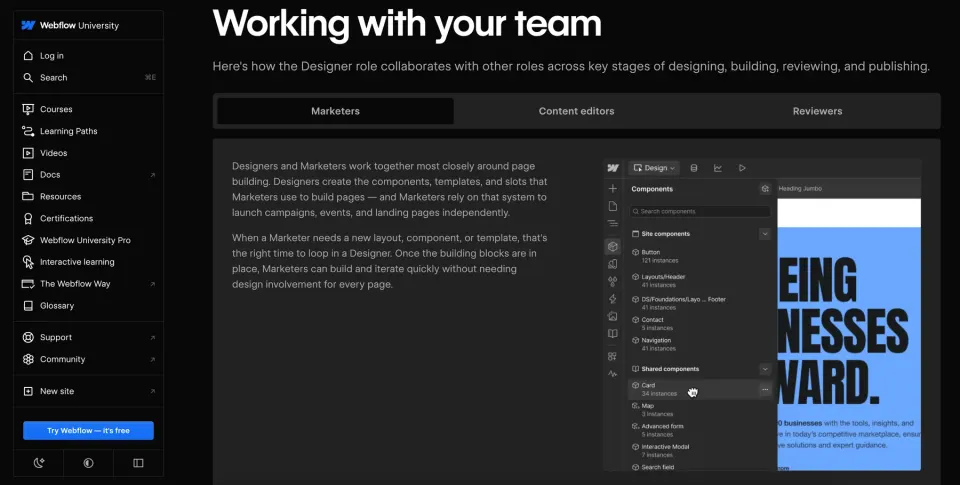
Vendor demonstration · 2026-11-26 · Source / documentation
If the client needs independent hosting later, establish what can be exported, what must be reconstructed and how redirects will be maintained. I would not promise a migration merely because a platform can download some page files. Verify the complete workflow against the business requirement. Keep a safe copy of original assets and approved copy, and avoid exporting sensitive records without an appropriate reason and permission.
My final decision document
At the end of the evaluation I would write a one-page decision with the proposed platform, the alternatives considered, the requirements it satisfies, the unresolved risks and the actual quote date. The client should be able to revisit that document in a year and understand why the choice was made. If a requirement changes, the decision can change with it.
For specific evaluations, see my research reviews of Squarespace, Wix, Framer and Webflow. Compare the operating model with WordPress or my Astro overview where relevant. The Website Builders hub brings those reading paths together.
I care more about whether the client can run the resulting site than whether the builder is fashionable. The platform is a decision made for a particular business, not a permanent statement about what kind of developer I am.