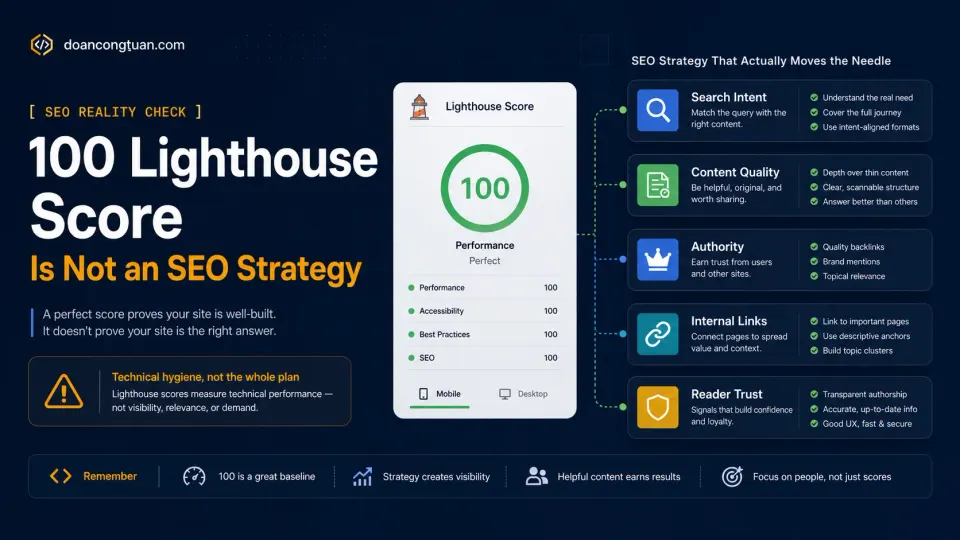
Getting a 100 Lighthouse score feels good. I will not pretend it does not. After spending time fixing gzip, removing render-blocking Google Fonts, delaying analytics, improving contrast, and building a responsive image workflow for this site, seeing near-perfect scores felt like a small victory.
But here is the uncomfortable truth:
A 100 Lighthouse score is not an SEO strategy.
It is a technical checkpoint. A useful one, a satisfying one, but still only a checkpoint. A page can score 100 and still fail to rank. It can load instantly and still be useless, or pass every technical audit and still miss search intent completely. That is the part I need to remind myself every time I start enjoying the score too much.
Is a 100 Lighthouse score an SEO strategy?
Before I say what Lighthouse cannot do, I want to be clear about what it can do. Lighthouse is useful: it catches things that are easy to miss when you are busy writing, designing, or shipping a site. It can show you:
Images are too large.
The LCP element is slow.
JavaScript is blocking the main thread.
Text contrast is weak.
Compression is missing.
Links or buttons are not accessible.
Best-practice headers are missing.
Those are real problems. During the performance cleanup on doancongtuan.com, Lighthouse pushed me to inspect things I might have ignored. The site was already built with Astro, static and loading quickly in real use, but Lighthouse still exposed production details that needed work. That cleanup became two deeper articles:
How I Took My Astro Site from Good to 100 Lighthouse Scores
Astro Image Optimization with Sharp
So I am not anti-Lighthouse. I use it, I like it, but I do not think it should become the whole SEO strategy.
Technical hygiene is not the same as strategy
The easiest way to think about Lighthouse is this:
Lighthouse = technical hygiene
SEO strategy = why the page deserves to rank
Technical hygiene matters. A site with poor performance, broken accessibility, messy redirects, and huge images is making life harder for users and crawlers alike. But hygiene is not strategy. Brushing your teeth does not make you a great public speaker; it only removes one obvious problem before you speak. That is how I see Lighthouse. A clean score means the site is not obviously fighting itself on the technical side, but the page still has to answer:
Who is this for?
What query does it satisfy?
Is the answer better than what already ranks?
Does it show real experience?
Is it organized clearly?
Does it link to supporting pages?
Does it deserve trust?
Lighthouse does not answer those questions. SEO does.
What a 100 score can actually help with
A 100 Lighthouse score can still help in several practical ways.
It reduces avoidable friction
If a page is slow because of oversized images or blocking scripts, some users will leave before reading. Fixing that matters. It does not guarantee rankings, but it gives the content a fairer chance.
It makes the site feel more professional
Fast pages, readable text, clean layout, and stable rendering create trust. That trust is hard to measure, but it is real. If your site feels broken or heavy, users notice.
It gives you confidence in the technical foundation
This is the biggest benefit for me. When the technical foundation is clean, I can stop wondering whether performance is the main problem. If an article does not rank, I can look at other causes:
Maybe the search intent is wrong.
Maybe the article is too thin.
Maybe the SERP is too competitive.
Maybe the page needs better internal links.
Maybe the topic needs a stronger cluster.
Maybe I need more original experience.
That clarity is useful. It shifts the question from “is my site broken?” to “is my content good enough?”, which is a much more productive place to be.
It helps with Core Web Vitals thinking
Lighthouse is not the same as field data, but it trains you to care about the right things:
LCP
CLS
INP-related JavaScript cost
image weight
render-blocking resources
mobile experience
That mindset helps you build better pages.
What a 100 score cannot do
Now the important part.
A 100 Lighthouse score cannot fix weak content. If your article does not answer the searcher’s real question, the score does not matter. It cannot create authority either. If competitors have stronger topical coverage, better links, more trust, and years of history, a perfect score does not erase that gap.
It cannot replace experience. If the article sounds generic with no proof, screenshots, mistakes, tradeoffs, or personal testing, the page may still feel like every other AI-generated article online. It cannot choose the right keyword. You can perfectly optimize a page targeting a query nobody searches for.
It cannot build internal links. If the page is isolated, Google and users may not understand how it fits into the site. And for affiliate content, it cannot make a page trustworthy. Trust comes from honest comparisons, clear disclosures, real usage notes, limitations, and not pretending every product is perfect.
That is the difference. Lighthouse can tell you whether the room is clean. It cannot tell you whether the meeting inside the room is useful.
The trap of performance perfection
There is a dangerous point in every optimization sprint. You fix the big things. The page reaches 95, then 98, and then you start chasing the final one or two points. Sometimes that is worth it. Often it is not. If the homepage is at 99 and the article pipeline is weak, the next best SEO action is probably not another two hours inside Lighthouse. It is probably:
Write the next supporting article.
Improve an old intro.
Add original screenshots.
Build a comparison table.
Add internal links to a pillar page.
Rewrite thin sections.
Add FAQ answers.
Update pricing notes.
Improve the title.
Check the SERP again.
That is where I have to be careful. Performance work feels concrete: Lighthouse gives you a number, and the feedback is immediate. Content strategy feels messier; search intent does not hand you a score. So it is tempting to keep polishing the dashboard because the progress feels visible. But SEO does not reward the cleanest screenshot. It rewards the page that best satisfies the user and earns trust over time.
How I think about the right balance
For my own sites, I work from a simple rule:
Get the technical foundation clean enough that it is not the bottleneck.
Then move back to content and links.
For an Astro static site, “clean enough” might mean:
Performance: 90+
Accessibility: 95+
Best Practices: 100 or close
SEO: 100
No obvious image delivery warnings
No major render-blocking resources
No broken mobile layout
No bad contrast warnings
If a page reaches 98 instead of 100, I am not going to panic. If the page is useful, fast, readable, and technically clean, the next improvement should usually happen in the content. For important pages I may still chase 100, since those pages represent the site. For everything else, I do not need to turn Lighthouse into a religion.
What to do after Lighthouse is clean
Once the technical side is clean, the real SEO work begins.
1. Re-check search intent
Ask what the searcher actually wants. For example, someone searching:
astro image optimization sharpprobably wants code. Someone searching is astro good for seo probably wants a practical explanation, tradeoffs, and examples. Someone searching wordpress vs astro probably wants a decision framework. If the article does not match the intent, speed will not save it.
2. Add original experience
This is where small sites can compete: do not only explain the concept, show what happened when you applied it. For this site, that means I can talk about:
my old WordPress workflow
PremiumPress coupon sites
WP Rocket and Smush Pro
Simply Static exports
Astro build output
Nginx gzip checks
Sharp image variants
Lighthouse before and after
That is much stronger than generic advice.
3. Build topic clusters
One article alone is rarely enough. A strong topic needs supporting pages. For my Astro performance cluster, the structure now looks like this:
Main case study:
How I Took My Astro Site from Good to 100 Lighthouse Scores

Supporting opinion:
Astro Is Fast, But It Does Not Automatically Give You 100 Lighthouse Scores

Technical deep dive:
Astro Image Optimization with Sharp

Server layer:
Serving Astro with Nginx

SEO mindset:
A 100 Lighthouse Score Is Not an SEO Strategy
That cluster tells a better story than one isolated article.
4. Improve internal links
Internal links are not decoration. They help users and search engines understand which pages matter. A performance article should link to the image optimization article. The image article should link back to the main Lighthouse case study. The Nginx article should link to hosting and VPS guides. The WordPress vs Astro article should link into the Astro performance cluster. That is how a site starts to feel connected rather than just a pile of individual posts.
5. Update old pages
Sometimes the best SEO move is not writing a new article. It is updating an old page that already has impressions. Add a better intro, a direct answer, a table, screenshots, internal links. Improve the title. Make the page more useful. Lighthouse cannot tell you to do that. Search Console can.
Where Lighthouse fits in my workflow now
I still use Lighthouse, but as one stage, not the whole process. My rough workflow now is:
1. Build or update the page.
2. Check Lighthouse for obvious technical problems.
3. Fix major performance, accessibility, and best-practice issues.
4. Check live HTML and headers where needed.
5. Re-read the article for search intent and usefulness.
6. Add internal links.
7. Publish or update.
8. Watch Search Console over time.
That feels like a healthier process. The score is one signal, not the final judgment.
A simple way to explain it
If I had to explain this to a younger version of myself, I would say:
Lighthouse helps your page stop losing points technically.
SEO strategy helps your page earn attention.
Those are not the same job, and you need both. A technically broken site is a problem. A technically perfect but useless page is also a problem, just a different one. The goal is not to choose between performance and content. The goal is to use performance as the foundation for better content.
A quick note about the examples
When I mention 98–100 Lighthouse results, I am talking about my own testing on doancongtuan.com during this optimization pass. These numbers are useful as a case study, not as a universal SEO promise. A different site, page type, image setup, third-party script, device, network, or Lighthouse version can produce different results.
The honest bottom line
I am glad I optimized this site. The gzip fixes, font cleanup, analytics delay, contrast improvements, and Sharp image workflow were worth doing. The site is cleaner, the pages feel more professional, and the Lighthouse results are better. But I do not want to confuse the scoreboard with the game.
A 100 Lighthouse score is a good sign. It means the page is technically healthy in a lab test. It does not mean the page deserves to rank. The real SEO work is still the hard part:
understanding the searcher
writing something useful
showing real experience
building topical coverage
linking pages together
earning trust
updating content over time
Lighthouse is not the strategy. It is the floor. Once the floor is clean, you still have to build the house.