Research-based guide; no hands-on product test.
Test the owner-edited business site.
Investigate the required app and business workflows.
Evaluate design-led publishing and handoff.
Compare actual renewal, permissions and outcomes using the same test project.
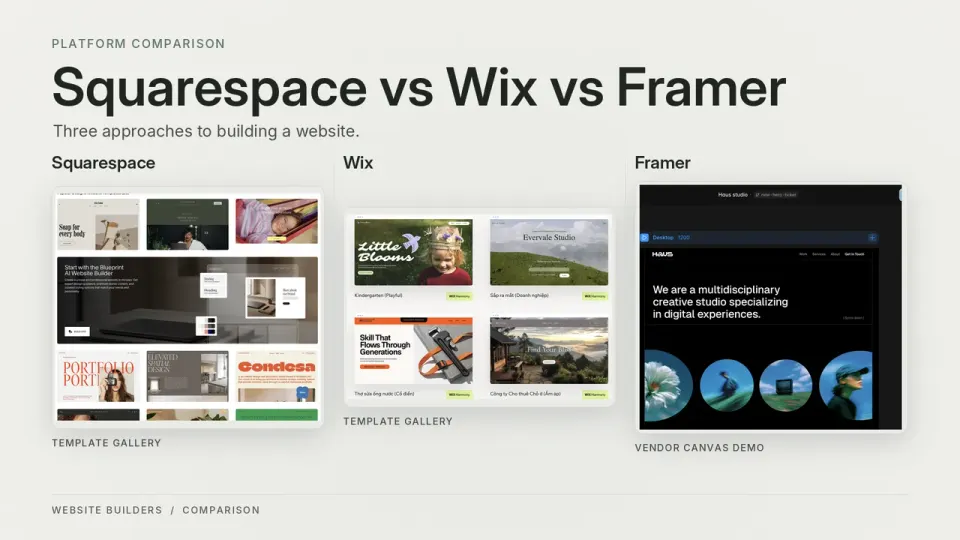
Three builders, three starting points
A portfolio owner, a workshop business and a SaaS startup might all ask for a website. Their requirements are not the same. I would never select a builder from a template gallery alone. The decision should come from the tasks the owner performs every week.
| Platform | Where I would start evaluating it | Trial task |
|---|---|---|
| Squarespace | Portfolio or compact service site | Publish a services page and inquiry form |
| Wix | Business site needing bookings or store tools | Run a sample booking or checkout |
| Framer | Design-led marketing site with CMS pages | Publish two entries from one CMS template |
The table is a shortlist, not a measured performance ranking. Each product has its own plan limits and editing model, and the specific feature may be available in more than one platform.
Check the cost of changing your mind
Keep the domain account and original assets organized. Ask how CMS items and products can be exported and what would have to be recreated manually. Record the current annual renewal price, any collaborator restrictions and the cost of applications. I would weigh these against the value of a shorter build and simpler handoff.
My shortlist would start with Squarespace for a compact site, Wix for an operations-heavy small business, and Framer for a designed marketing site. The winner is the one that completes the trial tasks without fragile workarounds. This comparison uses official product information rather than timed side-by-side testing.
Give every builder the same assignment
Build a landing page for a hypothetical design studio with a home page, three project entries, a service page and an inquiry form. Use the same image dimensions, headlines and form fields. Ask the person who will operate the site to replace a photograph and publish another project. The test should expose whether the workflow fits the operator, not which editor produces the most impressive demo.
Record the time and steps required to complete each task, whether any plan upgrade or integration is necessary, and whether the mobile layout is usable without further editing. Also check a page with an unusually long project title. A builder that looks great with carefully curated sample content may be harder to operate with the owner’s real copy. I would reject a candidate that misses a required business feature rather than give it an arbitrary numerical score.
Use a shared evaluation sheet
I would be careful about comparing these builders from their marketing sites. Each can show an impressive design, but the site owner will spend more time maintaining existing content than admiring a template. A useful trial puts the same small business into each environment. Use the same page names, text, images and required actions. Leave any missing feature marked unresolved instead of solving it with an unrelated paid service and then forgetting to count that service.
Squarespace is a candidate for a managed site with integrated editing and commerce. Wix is worth evaluating where its wider app and business-workflow options are relevant. Framer is a natural candidate for a design-led publishing or marketing site. These are editorial starting points, not measured rankings; confirm current capabilities directly in each builder’s official material.
| Test | What to record |
|---|---|
| Edit a service page | Can the owner find and change the required copy? |
| Add a project | Are repeated content elements manageable? |
| Open the phone version | Does important content remain visible and usable? |
| Submit an inquiry | Who receives it and where is it stored? |
| Hand over the account | Which roles, billing and domain rights are needed? |
| Estimate renewal | Include add-ons, required features and future changes |
Three different businesses, three different risks
A photographer needs a manageable portfolio and image-led pages. Start by testing the actual galleries and the editing workflow. An appointment-based studio may depend on booking rules, confirmation emails and staff availability; the booking path deserves attention before visual design. A software startup with a developer already on the team may value a flexible design and publishing workflow, but should still test who owns routine updates and integrations. A builder that works well for one of these teams may not match the next.
I would make a list of mandatory features before starting any trial. For a studio this could include a working inquiry or booking flow, business hours, a phone-friendly menu and clear service details. A platform that fails a mandatory feature needs a credible workaround with a cost and owner. A beautiful page does not compensate for an unreliable booking process.
Choose an owner, then a builder
The owner of the account should normally be the business that depends on the website. A designer or freelancer needs appropriate collaborator access rather than becoming the only person able to change billing or domain settings. Include access and permissions in every trial. If a team cannot agree who is responsible for an integration, even the best editor will not solve that organizational problem.
I would visit the current Squarespace, Wix and Framer documentation, complete a small shared trial and compare the results with the planned budget. The goal is an operating model that the real team can sustain, not a universal winner.
Compare the cost of the next feature, not just the first page
The first project in a trial often needs little more than a heading, a gallery and a contact link. Ask what the owner is likely to request next year. For the photographer, it might be a new portfolio collection and a more structured inquiry. For the studio, it could be a booking workflow with staff availability. For the marketing team, it could be a collection of product landing pages with shared content. Those are different tests, and they can change which platform fits.
Make the next feature explicit. Ask the vendor or inspect the documentation for whether it is native, plan-dependent, offered through a separate service or requires a custom solution. Record the answer and the cost rather than assume a missing capability is available through an app. If the feature is merely desirable, the team may decide it can wait. If it is mandatory, it becomes a purchase gate. I would not let a builder’s strongest demo feature override an unresolved business requirement.
A weighted worksheet without invented scores
If you need to present a comparison to a client, use the following process. Assign the criteria before trialing any builder. For example, a small studio might place 30 percent of its decision on owner editing, 30 percent on mandatory business workflows, 20 percent on cost, 10 percent on portability and 10 percent on design flexibility. A developer-owned marketing site could use completely different weights. These numbers represent the fictional studio’s priorities, not product scores.
Then record evidence against each requirement. Any mandatory failure disqualifies the option until there is an accepted alternative. Only after completing the trials would I consider assigning a simple score to comparable outcomes. Keep missing evidence blank rather than treating it as average. This prevents a polished marketing page from winning points for features that nobody has actually tried.
Finally, make the client aware of the limitations. If the platform’s export will not reproduce the final site, list the assets and content the business should retain. If a design add-on is proposed, include the independent renewal and removal conditions. The Squarespace versus WordPress comparison covers another operating model if none of the three managed builders fits the brief. The objective is a defensible decision that can be revisited as the business changes.
Continue reading
References
Continue with a more specific comparison
If you have narrowed the choice to an appointment or inquiry-led business, use Squarespace vs Wix. If you are evaluating a design team and its CMS workflow, read Framer vs Webflow. The website builder cost guide helps compare the actual team and renewal costs.